Reiki, Vairocana Buddha, and Seeing Reality as Mandala
Makoto ReikiDo as a Dharma Practice
Makoto ReikiDo emerged through many years of dedicated Reiki practice alongside immersion in the Buddha Dharma. In particular the teachings and contemplative traditions associated with Mahāvairocana Buddha (Dainichi Nyorai). It became apparent over time that many of the deeper principles within Reiki could be understood through the language of Esoteric Buddhism. This adoption offered practitioners a richer framework for exploring healing, awakening, and the nature of reality itself. These teachings can seem unfamiliar at first, however they provide a way of understanding Reiki that extends beyond technique and into direct participation with the interconnected fabric of life.
In the following, we explore three foundational concepts that help illuminate this perspective: 1. Vairocana Buddha, the embodiment of all-pervading awakening; the 2. Dharmadhātu, the boundless field in which all phenomena arise and interconnect; and the principle of 3. Mandala, a way of seeing reality as an integrated expression of wisdom, compassion, and relationship. These ideas form the philosophical and experiential foundation through which Makoto ReikiDo understands Reiki practice, the Reiki symbols, and ultimately the meaning of Dai Kō Myō as the expression of the Great Bright Light of awakening. Therefore, understanding these principles provides a bridge between traditional Reiki practice and the deeper realisation that Reiki is not merely something we use, but something we learn to recognise as already present within the mandala of our lives.
Looking Beyond Reiki as a Healing Technique
For many people, Reiki begins as a method of healing. Through hands-on practice, meditation, and self-treatment, practitioners experience greater calm, balance, and wellbeing. Yet for those who continue deeply into the path, a natural question often emerges: What is the deeper source of Reiki?
Makoto ReikiDo, understands Reiki as more than a healing modality. It is viewed as a path of awakening through the wisdom teachings of Mahāvairocana Buddha, the central Buddha of Esoteric Buddhism.
This perspective does not replace traditional Reiki practice. Rather, it provides a framework through which the deeper meaning of Reiki can be understood and directly experienced.
Who is Vairocana Buddha?
 Vairocana, known in Japanese Esoteric Buddhism as Dainichi Nyorai, is the embodiment of ultimate reality itself. Dai Kō Myō, often translated as the “Great Bright Light,” can be understood as expressing the luminous wisdom of Dainichi Nyorai (Mahāvairocana), the Buddha whose awakening pervades all reality.
Rather than being viewed as a historical figure or celestial deity, Vairocana represents the all-pervading awakened nature that is present throughout the universe.
The Mahāvairocanābhisaṃbodhi Sūtra describes Vairocana as the source from which all enlightened qualities arise. His light illuminates all phenomena without preference or limitation, revealing the inherent interconnectedness of existence.
When Reiki is viewed through this lens, Reiki is no longer understood merely as an external energy. It becomes the living activity of awakened reality itself, continuously expressing through all life.
Understanding the Dharmadhātu
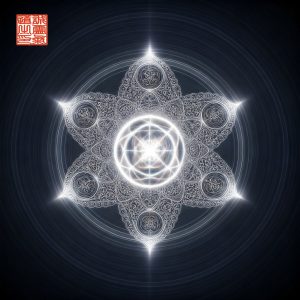 Central to this view is the principle of the Dharmadhātu.
The Dharmadhātu can be understood as the all-encompassing field of reality in which everything exists. It is the totality of life before we divide experience into separate categories of self and other, good and bad, spiritual and ordinary.
Just as waves appear separate while remaining inseparable from the ocean, all phenomena arise within and are inseparable from the Dharmadhātu. From this perspective, people, relationships, emotions, thoughts, environments, and events are not isolated occurrences. They are interconnected expressions of a single living reality.
The purpose of spiritual practice is not to escape this reality but to recognise it more clearly. Life is where the work is.
Seeing Through the Lens of Mandala
 The Dharmadhātu is often represented symbolically through the principle of Mandala.
A mandala is frequently mistaken for a sacred image or spiritual artwork. With this in mind in reality, it represents a way of seeing, this point is important to understand.
The mandala view reveals that everything exists in relationship with everything else. Nothing stands alone. Every aspect of our experience participates in a vast network of causes, conditions, and awakened potential. This we begin to learn through Third symbol Reiki practice.
When we adopt the view of life as a mandala:
- Difficult situations encountered in life become opportunities for learning
- Emotions become gateways to wisdom
- Relationships become fields of practice
- Daily life becomes part of the path itself
Rather than seeking awakening somewhere else, the practitioner learns to recognise awakening within life itself, in fact life is the practice ground.
Reiki as Participation in the Mandala
As practitioners deepen in Reiki, they often begin to notice that treatment is not simply something one person gives to another. Practitioner, recipient, environment, intention, body, mind, and circumstance all participate in a single interconnected process.
This reflects the mandala principle. The Reiki practitioner does not stand outside reality directing energy toward a problem. They become a conscious participant within a much greater field of interconnected awakening.
Through treatment, meditation, mantra, and contemplation, the practitioner gradually learns to perceive life less through the lens of separation and more through the lens of participation.
Why This Understanding Matters
Without an understanding of the Dharmadhātu and mandala, Reiki can easily be reduced to a technique. With this understanding, Reiki becomes a path.
Healing is therefore is no longer viewed simply as fixing what is wrong. In fact, healing becomes the restoration of harmony within the greater mandala of life. Practice becomes a process of recognising the interconnected nature of reality and learning to embody wisdom and compassion within it.
It is from this foundation that the Reiki symbols reveal their deeper meaning.
The symbols are not merely tools for directing energy. They are expressions of the enlightened activity of Vairocana, guiding practitioners toward purification, integration, wisdom, and the direct recognition of their true nature.
With this understanding of Vairocana, the Dharmadhātu, and the mandala view of reality, we can now explore the First Reiki Symbol. Rather than a symbol of power alone, it can be understood as a profound expression of purification and harmonisation within the mandala of awakened reality.