
Karma, Cause and Effect: Life as the Path to Unveiling the Truth
Karma not what you think
Many people encounter the idea of karma as a system of reward and punishment, where good deeds bring good fortune and harmful actions lead to suffering. While this understanding contains an element of truth, the Buddhist view of karma is far more profound. Karma is not a cosmic judge. Rather, it is the natural law of cause and effect that shapes our experience and influences the unfolding of our lives.
From this perspective, life itself becomes the path. Every circumstance, challenge, relationship, success, and disappointment provides an opportunity to understand how causes give rise to effects and, ultimately, to uncover the deeper truth of who and what we are.
Understanding karma gives us greater power because it shifts us from blame to responsibility, reminding us that our thoughts, words, and actions shape the conditions of our future experience.
This is why in Makoto ReikiDo our Foundational Teachings are grounded in Buddhist Philosophy which lifts the precepts with the depth of understanding that they so deserve.
Understanding Karma
The Sanskrit word karma simply means “action.” In Buddhism, karma refers primarily to intentional actions of body, speech, and mind. Every thought we repeatedly cultivate, every word we speak, and every action we perform plants seeds that eventually ripen into experiences.
- Anger tends to create conditions for conflict
- Kindness creates conditions for harmony
- Generosity opens pathways for abundance
- Fear often perpetuates insecurity
Karma is therefore less about external events happening to us and more about the habitual patterns through which we engage with reality. These patterns become the lens through which we perceive ourselves, others, and the world.
The Buddha taught that everything arises through dependent origination which is the Buddhist teaching that:
Nothing exists independently. Everything arises in dependence upon causes, conditions, and relationships.
 We can consider the law of cause and effect in this way – A flower depends on a seed, soil, water, sunlight, and countless other conditions. Remove the necessary causes and conditions, and the flower cannot arise and grow. The same applies to our thoughts, emotions, identities, and experiences.
Karma is one aspect of this vast web of interdependence.
The Karma of Past Lives
The Buddhist tradition also recognises that the causes shaping our present circumstances extend beyond this lifetime.
Some people naturally encounter supportive conditions, while others face significant challenges from an early age. While not everything can be explained through karma alone, Buddhism suggests that the tendencies, dispositions, and circumstances we experience may have roots in previous existences.
This view is not intended to encourage blame or fatalism. Rather, it inspires responsibility and hope. Regardless of the causes that brought us here, the present moment remains alive with possibility. Every choice we make now becomes a cause that shapes future experience. We cannot change the past, but we can transform our relationship with it.
The fact that we have encountered spiritual teachings, have the capacity to reflect on our lives, and possess the opportunity to engage in practice is itself considered an extraordinarily precious circumstance.
The Reiki precepts remind us of the principle of karma and dependent origination. They encourage us to become mindful of the causes and conditions we create through our thoughts, words, and actions. Rather than promoting blame or judgment, they point to the possibility of transformation, showing that every moment offers an opportunity to cultivate causes for greater wisdom, compassion, and wellbeing.
Life Exactly as It Is
One of the most liberating insights on the spiritual path is recognising that our lives are not obstacles to awakening. Our lives are the very ground upon which awakening occurs.
When we resist reality, we often create additional suffering. We fight circumstances we cannot change and become trapped in stories about how life should be different. Yet the circumstances before us are the ripened result of countless causes and conditions.
This does not mean accepting injustice or refusing to improve our lives. Rather, it means beginning from what actually is. The person we are today, the challenges we face, the relationships around us, our strengths and weaknesses, and the opportunities available to us are all part of the karmic landscape through which wisdom can emerge.
Life becomes easier when we stop asking,
- “Why is this happening to me?” and begin asking,
- “What is this experience teaching me?”
We cannot rewrite the causes that brought us to this moment, but we can choose the causes we create now. In that choice lies the power to transform our future experience and move steadily toward awakening. Absolutely amazing !!
The Gift of the Reiki Precepts
Within Reiki practice, the Five Precepts provide a practical framework for transforming karma. The Reiki precepts are profoundly simple in their presentation but remarkably powerful and direct:
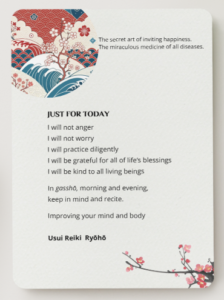 Just for today:
Do not anger
Do not worry
Be grateful
Practice diligently
kind to all beings
These are not just ethical guidelines but also methods for changing the causes we create from moment to moment:
- Every time we choose patience instead of anger, we weaken the karmic tendency toward conflict
- Every time we choose trust instead of worry, we interrupt patterns of fear and contraction
- Every expression of gratitude shifts attention away from scarcity and toward abundance
- Every act of kindness plants seeds that benefit both ourselves and others
The precepts invite us to become conscious participants in the process of cause and effect rather than unconscious victims of our habitual conditioning. The beauty of the Reiki Precepts lies in their simplicity, yet as our understanding deepens, we discover a profound wisdom capable of transforming the way we experience ourselves, others, and life itself.
Reiki as Karma Purification
From the perspective of Makoto ReikiDo, Reiki can be understood as more than a healing modality as it becomes a path of purification.
As practitioners cultivate presence, meditation, self-treatment, and compassionate action, previously hidden tendencies begin to surface. Old patterns of fear, attachment, resentment, and confusion become visible.
This can sometimes feel challenging. Yet what emerges into awareness does so because it is ready to be transformed. The role of Reiki is not to suppress these patterns but to illuminate them.
Like a lamp brought into a dark room, awareness reveals what was previously unseen. Through repeated practice, the practitioner gradually learns not to identify with these patterns but to recognise them as temporary expressions moving within a much larger field of awareness.
In this way, Reiki supports the purification of karmic tendencies and encourages the emergence of greater balance, clarity, and compassion.
Vairocana and the Purification of Perception
The teachings associated with Mahāvairocana Buddha take this understanding even deeper. Within the esoteric Buddhist traditions, suffering is often viewed as arising not simply from circumstances but from misperception.
- We mistake our thoughts for reality
- We grasp at what is impermanent
- We perceive ourselves as separate from the interconnected whole
Vairocana represents the awakened nature that has never been obscured, only temporarily concealed. Using the analogy of clear water, the water itself is never stained. Dirt may cloud its appearance, but the water remains fundamentally pure. Likewise, our Buddha-nature remains untouched by confusion, affliction, or karma.
Practices associated with Vairocana and the mandala help practitioners recognise that what requires purification is not the essence of who they are, but the obscurations that prevent direct recognition of that essence.
As awareness expands, the practitioner begins to see karma not as punishment but as a teacher. Each circumstance reveals something about attachment, perception, and interdependence. The very causes of suffering become gateways to wisdom.
Karma and the Mandala of Daily Life
 From the perspective of the Womb Realm Mandala, every experience can be viewed as an opportunity for awakening. The difficult colleague, the demanding family member, physical illness, unexpected loss, and moments of joy all become part of the mandala of practice.
Nothing needs to be excluded. Rather than dividing life into spiritual and ordinary experiences, the practitioner learns to recognise every circumstance as part of a larger field of enlightened activity.
- Each encounter offers an opportunity to cultivate patience
- Each difficulty offers an opportunity to develop wisdom
- Each moment of kindness becomes an expression of awakening
The world itself becomes the practice ground.
A Precious Human Life
Buddhist traditions often speak of the rarity of obtaining a precious human birth. Among countless possible circumstances, we have been born into conditions where we can hear teachings, engage in practice, help others, and consciously create the causes for greater freedom.
Whether our present circumstances are pleasant or difficult, each moment presents an opportunity to shape future causes.
- The question is not whether we have karma. We all do.
- The question is how we choose to work with it.
Through the guidance of the Reiki Precepts, the cultivation of compassionate action, and the transformative practices associated with Vairocana, we can gradually purify harmful tendencies and nurture the causes of balance, wisdom, and peace.
Ultimately, karma is not a sentence from the past. It is an invitation in the present. Life, exactly as it is, becomes the path through which truth reveals itself. Every thought, every action, every relationship, and every experience offers an opportunity to recognise our interconnected nature and awaken to the luminous reality that has always been present.
In this way, karma becomes not merely a doctrine of cause and effect, but a profound expression of possibility. The past may have shaped the conditions of this moment, but the choices we make now shape the path ahead. And within that recognition lies both freedom and responsibility, the heart of the spiritual journey itself.